
Schools of awakening exist because they are needed. By school we mean an entity devoted to the evolution of its students. At the head of a real school stands a conscious teacher. At the same time, a real school is directly monitored and nurtured by C Influence—Gods, or angels[1].
In order to define what a real school is it may be helpful to delineate what a real school is not. To do this we can examine various spiritual traditions. We are not referring to \”sham\” modern religions, as Gurdjieff called them. We are also not referring to a religion which began as a conscious school or group, but which became disconnected from conscious influences, or dead. The image below shows praying Buddhist monks in Thailand. They practice the outer meaning of religion, without conscious connection, if there is no awakened being leading them.
A group may have a conscious teacher. Examples are the groups of Gurdjieff and Ouspensky. These conscious beings could produce themselves, as a modern day spiritual teacher advises. They could not produce presence in their students, as does a school. One group can give birth to another—e.g., Gurdjieff’s to Ouspensky’s.
A conscious tradition is not a school. One example is the building of the Gothic cathedrals[2]. Such enterprises may involve conscious beings, but are not schools in the strict sense. A school requires a teacher to induce presence, or self-remembering, in a (often large) body of students. Christ’s school is one such example. It may be worth mentioning that Christ\’s school produced Paul[3], as a conscious being who was not a direct disciple of Jesus.
Why do we need a school, then? First and foremost, a school materializes presence–consciousness–in its students. At the same time, a school has an external task. The Egyptian tradition is the first historical record of formalized schools on this planet, while the task of Jesus’ school seems to have been to spread a message of love[4].
Another example are the Freemasons. They uphold a tradition with links to spiritual development, but without the outside help of conscious influences. Such outside help is a key ingredient.
Fourth Way authors describe school work as proceeding along three lines. In the first line, one works for oneself. The second is work to assist one’s fellow students. In the third, one works for the school. As a modern-day spiritual teacher put it, “as long as one balances the three lines of work, one is relatively safe”. ‘Safe’ here means retaining the school and Influence C.
A word about service may be in place. Spiritual evolution implies the existence of the higher and the lower. One must be able to recognize the higher, and serve it. At the same time, one has to take the higher on its own conscious[5]terms. This stands in contrast to the plight of many who unwittingly serve their lower parts[6]. One must break through imagination into self-remembering, and stay there.
“Ascend, I follow thee, safe Guide, the path. Thou lead\’st me, and to the hand of Heav\’n submit.” John Milton[7]
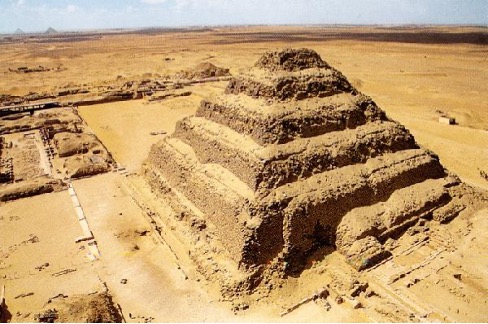
Ultimately, school work implies patience. The image above shows the pyramid of Saqqara (27th century BC), the first Egyptian pyramid. Its step structure reminds us that spiritual evolution requires great patience, and often proceeds step by step.
The author has been a student of the Fourth Way for four decades. For other articles in the FourthWayToday magazine by Benjamin, see: https://www.fourthway.cn/wp-content/uploads/2026/04/Saqquara-1.jpgauthor/benjamin-b/.
[1] Women or men who produced an immortal astral body in their brief sojourn upon the Earth.
[2] Dominant in Europe from the 12th to 16th centuries.
[3] A Christian apostle (messenger) who spread the teachings of Jesus in the first-century AD.
[4] As well as to rejuvenate the Jewish tradition.
[5] As a present day spiritual teacher put it.
[6] Synonymous with the ‘lower self’.
[7] John Milton, 1608-1674, English poet, polemicist, and civil servant.